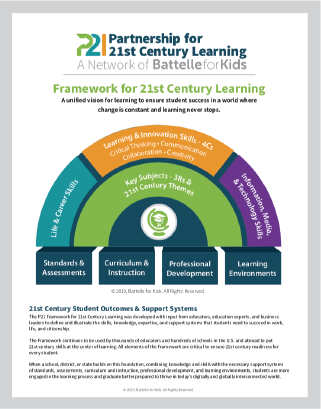
| Download the 2-page 21st Century Overview: Readiness in Kansas. |

Kansas is focused on creating opportunities for stakeholders to work together to ensure student success by expanding their vision beyond current measures of learning to include knowledge, skills, and competencies students need to live, learn and thrive in a 21st century environment.
Accelerating technological advances, a rapidly changing knowledge base, an interconnected workforce, and an increasingly global society have combined to create the need for students to be 21st century-ready. To support this effort, the Kansas Department of Education (KSDE) has developed “profiles” of the 21st Century Learner and 21st Century Learning Environment. These profiles assist educators in re-designing their schools and classrooms and help guide the work of the department. The profiles can be found at: www.ksde.org/learn21.
KSDE is creating a database that brings together all academic standards, the Career and Technical Education clusters, and the 21st Century Learner Profiles. The database will dynamically link the standards to databases that include student achievement data (assessment scores), instructional resources, and student demographics. Links to the Kansas Common Core Standards will be added once they are adopted by the state board of education. This database will be able to deliver information linking student career choices to instructional decisions. By utilizing the 21st Century Learner Profiles as the central link among standards, the database will help educators create instructional resources and assessments that fuse the three Rs and four Cs (critical thinking and problem solving, collaboration, communication and creativity and innovation).
The Kansas Technology Rich Classroom (TRC) Program, funded through Enhancing
Education Through Technology (EETT), seeks to provide evidence that creating 21st century learning environments supported by strong, ongoing professional development for teachers can result in improved student learning in the areas of reading, math and science. The program, targeting grades 3-8, provides hardware, training and on-going classroom support through a technology facilitator that works side-by-side with project teachers. This intensive support, coupled with the 21st century learning tools, provided through the EETT grant, expands teachers’ ability to engage students in real-world, content-driven learning experiences that help cultivate 21st century readiness.
Kansas is leading a six-state effort to envision a new system of educator recruitment, preparation, development and empowerment to transform today’s traditional schools into places of dynamic learning. Key foci of this collaborative research exploration include the recruitment and retention of teachers, generational considerations, 21st century teaching and learning skills, career continuum blueprints and educator assessment instruments. The six states involved are Kansas, Missouri, Arkansas, Utah, South Dakota and West Virginia, with partnership support from the National Staff Development Council and Educational Testing Service.
The Kansas Academy of Mathematics and Science (KAMS) is an intensive two-year residential academy for 11th and 12th grade students who display exemplary talent in mathematics and science as well as a high degree of drive, interest, maturity, stability and personal and family commitment. KAMS students enroll in college courses taught by the faculty of a post-secondary educational institution. Over the course of their time in the Academy, students earn a high school diploma and 68 hours of college credit, meeting the requirements for an associate of arts or associate of science degree.
The Kansas Career Pipeline (KCP) is a non-profit organization with the mission of engaging students in using Kansas’ educational system to reach their career and life goals. The KCP seeks to accomplish this mission through a collaborative online effort between various state agencies and representatives from Kansas business and industry communities. The KCP provides resources to raise career awareness to help students make informed career choices.